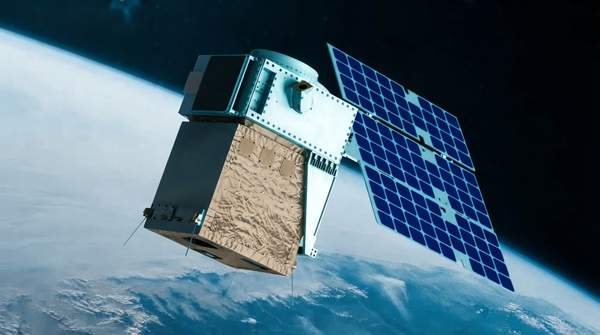
Lockheed Martin, an aerospace and defense firm, has disclosed advancements in nuclear propulsion systems, next-generation satellite communication, and accelerated spacecraft manufacturing processes.
More powerful and efficient propulsion, resilient communication networks, and sustainable power sources on celestial bodies address critical logistical and operational challenges for future missions to the Moon, Mars, and beyond. These developments enable long-duration exploration and potential resource utilization outside Earth's orbit, building foundational infrastructure for a sustained deep-space presence.
What We Know So Far
- Lockheed Martin is developing a fission surface power (FSP) system designed to use a compact fission reactor to generate electricity on the Moon, according to the company's website.
- The company is also investing in both nuclear electrical propulsion (NEP) and nuclear thermal propulsion (NTP) systems to facilitate more efficient space travel, as reported by lockheedmartin.com.
- A forthcoming GPS IIIF satellite will provide positioning, navigation, and timing (PNT) capabilities with what Lockheed Martin states is more than 60 times greater anti-jamming technology.
- The firm's Small Satellite Processing & Delivery (SPD) Center is capable of producing up to 180 spacecraft per year, according to company data.
- Lockheed Martin reports that it currently has over 80 space projects and programs that are utilizing artificial intelligence (AI) and machine learning (ML).
- Separately, an analysis of the commercial viability and resource potential of moon mining is being explored, according to a report from Discovery Alert.

Innovations in Satellite Communication Technology
Advancements in satellite communication and navigation networks focus on enhancing their resilience and capability. These systems form the backbone of terrestrial and space-based operations, making robust technology development essential to ensure uninterrupted service for military, civil, and commercial users.
According to Lockheed Martin, its next-generation GPS IIIF satellite is engineered to provide a significant leap in PNT capabilities. The key enhancement is a reported 60x increase in anti-jamming technology. This feature is designed to protect the satellite's signal integrity against intentional and unintentional interference, a growing concern for critical infrastructure that relies on precise timing and location data. Enhanced PNT services are fundamental for autonomous navigation, global logistics, and coordinated defense operations.
Underpinning the deployment of such advanced constellations is a parallel innovation in manufacturing. The company's Small Satellite Processing & Delivery (SPD) Center employs six parallel assembly lines, enabling a production capacity of up to 180 spacecraft annually, according to its website. This high-throughput model facilitates the rapid replenishment and expansion of satellite networks. The center supports platforms like the LM 400 mid-sized satellite bus, which can accommodate payloads of up to 1,100 kg, allowing for a diverse range of missions from Earth observation to communications.
Furthermore, the integration of artificial intelligence is becoming standard practice in managing these complex systems. Lockheed Martin states it has over 80 space programs currently using AI and machine learning. These technologies are applied to areas such as satellite health monitoring, autonomous operations, and data processing, which can improve mission efficiency and reduce the need for constant human intervention. The use of AI is a key enabler for managing the large, interconnected satellite constellations that define modern space infrastructure, a field also explored in free online AI courses offered by institutions like Harvard.
Next-Generation Space Propulsion Systems
Investment in advanced propulsion systems, moving beyond traditional chemical rockets, is critical for future space exploration. Nuclear-based propulsion offers a path to reduce transit time and increase payload capacity for Moon and Mars missions, promising a new era of deep-space travel.
Lockheed Martin has confirmed it is investing in two primary forms of nuclear propulsion: nuclear thermal propulsion (NTP) and nuclear electrical propulsion (NEP). According to the company, these systems offer significant efficiency gains over conventional methods. While both utilize a nuclear fission reactor as the core power source, they apply that energy in fundamentally different ways to generate thrust, each with distinct advantages for specific mission profiles.
An NTP system functions by using a nuclear reactor to heat a liquid propellant, such as hydrogen, to extreme temperatures. The superheated gas is then expelled through a nozzle to create powerful thrust. According to technical analyses, this method can produce a specific impulse (a measure of efficiency) roughly double that of the best chemical rockets. This increased efficiency could dramatically shorten mission timelines, potentially reducing a trip to Mars from over six months to as little as three or four, thereby lessening astronaut exposure to deep-space radiation.
In contrast, an NEP system uses the reactor to generate a large amount of electricity. This electricity then powers a highly efficient thruster, such as a Hall thruster, which uses electromagnetic fields to accelerate and expel ions. While NEP systems provide very low thrust compared to NTP or chemical rockets, they are exceptionally fuel-efficient and can operate continuously for years. This makes them ideal for long-duration missions, such as transporting heavy cargo to Mars ahead of a crewed mission or for robotic probes venturing into the outer solar system.
How New Space Technologies are Shaping the Future
Emerging technologies in power, propulsion, and communication are shaping the framework for a sustainable human presence beyond Earth. Establishing permanent bases or outposts on the Moon or Mars demands infrastructure for extended living and working, with current space technology trends aimed at solving these long-term logistical challenges.
A cornerstone of this future infrastructure is a reliable and continuous power source. According to Lockheed Martin, its development of a fission surface power (FSP) system is designed specifically for this purpose. The FSP would use a small, compact fission reactor to generate a steady supply of electricity on the lunar surface, independent of sunlight. This capability is critical for surviving the two-week-long lunar nights and for powering habitats, life support systems, and industrial activities like in-situ resource utilization (ISRU).
The development of such power systems aligns with growing interest in the economic potential of celestial bodies. A report from Discovery Alert notes that analyses are underway regarding the commercial viability and resource potential of moon mining. Activities like extracting water ice from polar craters or mining for minerals like helium-3 would be highly energy-intensive, making a robust power grid like that proposed by FSP a non-negotiable prerequisite for any serious resource extraction effort.
What We Know About Next Steps
Official deployment timelines for the fission surface power system, GPS IIIF satellite, or advanced nuclear propulsion systems are not detailed in publicly available materials. Information from lockheedmartin.com focuses on current development and investment in these technological areas, indicating a strategic focus on building foundational capabilities for future lunar and deep-space missions. Specific launch dates or operational milestones, however, remain unannounced.