Software-defined vehicles (SDVs) are not simply cars with more code. They represent what researchers Eirini Liotou and colleagues at Harokopio University of Athens describe as a major paradigm shift: transforming traditional hardware-centric systems into software-centric platforms capable of dynamic adaptation and continuous functional evolution. The reason the industry keeps talking about a "cleaner foundation" is that the old way of building vehicle software—tied tightly to individual electronic control units—actively blocks the updates, personalization, and cross-domain innovation that define the SDV promise.
The Evolution to Software-Defined Vehicles: A Paradigm Shift
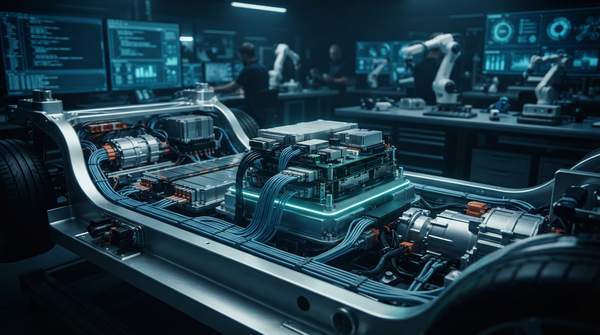
Traditional vehicles were built around dozens of small computers. As the Garage podcast discussion hosted by Sonatus explains, a classic car might carry as many as 150 single-function ECUs, each dedicated to one specialized job for its entire lifetime. OEMs and Tier 1 suppliers have wanted to consolidate these units to simplify the vehicle, reduce cost and weight—but as that same discussion notes, hardware consolidation demands far more software.
The architecture evolved in stages. According to the arXiv survey on the rise of the SDV, domain-based architectures first grouped related functions under centralized domain controllers, and more recently zonal and centralized architectures were introduced to reduce wiring complexity, improve scalability, and enable software-driven vehicle functionality. That architectural evolution, the authors argue, forms the technological foundation of the SDV itself.
The pressure behind this shift is practical. Traditional automotive development remains closely tied to specific ECUs, chips, operating systems, and vehicle networks—a tension the OpenChain project's automotive SDV track highlighted during a programme hosted at Bosch in Feuerbach, Germany. The industry's answer is a flexible software stack that can move between hardware environments rather than a single central computer.