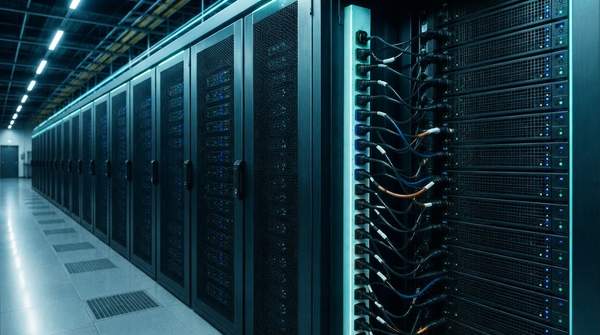
Last week, Dell Technologies Inc. saw an 88% jump in revenue, with its stock closing up 33%, largely driven by AI server sales. The company's revenues reached almost $44 billion for the quarter, according to SiliconANGLE, proving significant demand for robust AI infrastructure.
While the popular narrative focuses on rapid AI software advancements, tangible performance gains and financial benefits are currently realized in underlying hardware infrastructure. Market attention is shifting to foundational capabilities.
Businesses increasingly recognize that efficient AI infrastructure directly impacts their competitive edge and bottom line. Efficient AI infrastructure drives market leadership consolidation among top-tier hardware providers like Dell, which offer optimized AI workload solutions.
1. Dell's Dominance in AI Performance Benchmarks
Best for: Enterprises requiring high-performance, validated AI infrastructure
Dell Technologies Inc. consistently achieves world-record performance in AI and machine learning benchmarks, proving its hardware efficiency. The Dell PowerEdge R6715 delivered world-record TPCx-AI price and performance results, according to Infohub Delltechnologies. The Dell PowerEdge R760, equipped with NVIDIA L40S GPUs, showcased strong MLPerf Inference v4.0 performance, according to EnterpriseTechProvider (Q4 2023). This consistent benchmark leadership implies Dell's infrastructure provides a reliable foundation for scaling complex AI operations, reducing time-to-value for enterprises.
Strengths: Proven world-record performance; High GPU utilization; Extensive support and services | Limitations: Higher initial investment; Integration complexity for niche applications | Price: Enterprise-grade, varies by configuration
2. Nebius Group N.V.
Best for: Organizations seeking a full-stack cloud provider for AI workloads
Nebius Group N.V. reported revenue of approximately $529.8 million in fiscal year 2025 (ending January 31, 2025), a 350% year-over-year increase, with a net income of $101.7 million and a 19.2% net margin. This growth, noted by The Motley Fool, makes Nebius a significant full-stack cloud provider for AI workloads. The rapid expansion of a full-stack provider like Nebius suggests a growing market appetite for integrated, managed AI services that abstract away hardware complexities for users.
Strengths: Rapid revenue growth; Comprehensive cloud AI services; Strong net margin | Limitations: Less direct hardware benchmark data; Newer to global market compared to established giants | Price: Cloud-based, usage-dependent
3. NVIDIA
Best for: Developers and enterprises requiring leading-edge GPU technology for AI acceleration
NVIDIA GPUs, including the NVIDIA L40S and NVIDIA Tensor GPUs, power Dell's next-generation PowerEdge servers. These components are critical for achieving high MLPerf Inference v4.0 performance, directly contributing to Dell's AI infrastructure efficiency, as detailed by EnterpriseTechProvider. NVIDIA's continued innovation in GPU technology therefore directly dictates the performance ceiling for much of the enterprise AI hardware market.
Strengths: Industry-standard for AI GPUs; Wide software ecosystem; Continuous innovation in AI hardware | Limitations: High cost of advanced GPUs; Supply chain constraints for top-tier models | Price: Varies by GPU model and quantity
4. AMD
Best for: Enterprises exploring alternative high-performance GPU solutions for AI workloads
AMD's Instinct MI300X GPUs are integrated into Dell's PowerEdge XE9680 servers, enabling the 'World’s First MLPerf 4.1 Performance Results' for this configuration, according to infohub.delltechnologies.com (Q4 2023). This proves AMD's growing capability and role in providing powerful accelerators for advanced AI development. AMD's competitive performance in these benchmarks shows a maturing alternative to NVIDIA, potentially fostering greater competition and innovation in the high-performance AI accelerator market.
Strengths: Competitive performance in key benchmarks; Strong focus on data center AI; Expanding software ecosystem | Limitations: Smaller market share in AI GPUs than NVIDIA; Ecosystem still maturing | Price: Varies by GPU model and quantity
5. Intel
Best for: Enterprises requiring robust CPU infrastructure for general-purpose computing and AI workload orchestration
Intel Xeon Scalable processors are foundational components in Dell's next-generation PowerEdge servers, supporting diverse AI workloads. The Dell PowerEdge R760 delivered record-breaking VMmark results using Intel 5th Gen CPUs, as reported (Q4 2023) by infohub.delltechnologies.com, a critical factor for virtualized AI environments. While often overshadowed by GPUs for raw AI compute, Intel's continued dominance in CPU infrastructure plays an essential role in orchestrating and managing the broader AI ecosystem, especially in hybrid cloud environments.
Strengths: Ubiquitous in data centers; Strong ecosystem for virtualization; Solid performance for CPU-centric AI tasks | Limitations: Generally lower raw AI compute power than dedicated GPUs; Slower innovation cycle for AI accelerators | Price: Varies by processor generation and core count
Efficiency Edge: Dell vs. Self-Built Solutions
| Feature | Dell Optimized AI Infrastructure | Self-Built AI Infrastructure |
|---|---|---|
| GPU Utilization | 99% | 30% to 60% |
| Performance Benchmarks | World-record consistent results | Variable, often unoptimized |
| Operational Cost | Lower due to efficiency | Higher due to underutilization |
| Deployment Speed | Faster with pre-validated systems | Slower, requires extensive integration |
Dell's rack scale systems achieve 99% GPU utilization, a stark contrast to the 30% to 60% typically seen in self-built AI infrastructure, according to SiliconANGLE. This massive efficiency gap means many companies underutilize expensive hardware, effectively burning capital. Dell's optimized, purpose-built infrastructure offers a significant economic and operational advantage over ad-hoc solutions, directly impacting ROI and competitive agility. The difference in efficiency translates directly into financial outcomes and the speed at which AI initiatives deliver value.
Beyond Infrastructure: The Broader AI Ecosystem
While AI infrastructure remains critical, other significant players shape the broader AI ecosystem. Anthropic, for example, raised $65 million in new funding in Q4 2023, surpassing OpenAI in a recent investment round, according to SiliconANGLE. Continued investment in advanced AI models and research is evident.
Companies like SoundHound AI, which reported revenue of approximately $168.9 million for the year ended Dec. 31, 2025, a 99.4% increase, demonstrate growth in AI applications and services, as reported by The Motley Fool. While substantial funding and innovation flow into diverse AI applications, infrastructure providers like Dell enable these ventures' existence and scalability. Dell Technologies sells not just hardware, but a critical competitive advantage, positioning it as an indispensable backbone for cost-effective, high-performance AI deployment. If this trend continues, market consolidation among top-tier AI hardware providers like Dell will likely accelerate, further solidifying their foundational role in the AI economy.