Unmanned defense systems are evolving along three converging lines: AI-driven autonomy that moves analysis and decision-making to the point of action, swarm intelligence that lets coordinated drones act as a single entity, and layered counter-UAS architectures built to defeat both. Together, these trends are pushing militaries toward faster decision cycles, distributed operations, and defensive postures that no longer rely on a single expensive interceptor. The evidence base for this analysis is publicly available material from defense research institutions and industry reporting, and it points to a battlefield where the decisive question is no longer whether to field unmanned systems, but how quickly organizations and doctrine can absorb them.
The Unmanned Revolution: Key Technological Drivers
The common thread across current unmanned-systems development is the shift away from the classic collect-and-exploit model. Writing in National Defense Magazine, industry analysis describes how many systems today are designed to collect information and pass it to analysts for processing, while future systems will move analysis closer to the point of action — identifying relevant changes, prioritizing information, and providing recommendations in real time. That shift, the analysis notes, has the potential to reduce cognitive burden and improve decision-making in fast-moving environments.
The Australian Army Research Centre frames the same trajectory from the warfighting side. In its Land Power Forum discussion of how drones are changing modern warfare, it identifies AI-enabled drones and swarming drones as the innovations most closely associated with future possibilities and next steps. The center is careful about the present tense: there are debates about the current effectiveness of using AI in drones. But it singles out the areas where AI promises significant impact — terminal guidance, visual navigation, target detection, and swarming — and describes a future in which drones react autonomously to changing circumstances and communicate with each other to orchestrate a sortie.
On the defensive side, Defense Security Monitor, in reporting by Andrew Dardine, documents a parallel trend: counter-UAS is consolidating into layered, mobile protection solutions in which a single platform may carry a variety of sensors and effectors. The three trends are not independent. Autonomy enables swarming; swarming forces layered defenses; layered defenses in turn incorporate autonomy-enabled effectors of their own.
Key Trends in Unmanned Defense Systems
The table below synthesizes the three trends with sufficient public evidence, mapping each to its core technology and its documented strategic implication. It is drawn from the Australian Army Research Centre's assessment of future drone innovation, National Defense Magazine's analysis of edge computing and autonomy, and Defense Security Monitor's reporting on layered counter-drone defense.
| Trend | Core Technology | Strategic Implication |
|---|---|---|
| AI-driven autonomy | AI and machine learning applied to terminal guidance, visual navigation, and target detection, enabling drones to react autonomously to changing circumstances | Analysis moves to the point of action, with the potential to reduce cognitive burden and improve decision-making in fast-moving environments |
| Swarm intelligence | Coordinated drones that communicate with each other to orchestrate a sortie | Coordinated groups acting as a single entity challenge defenses built around engaging individual aircraft |
| Layered counter-UAS | System-of-systems platforms combining multiple sensors and effectors, including directed energy and autonomy-enabled systems | Resilient, non-kinetic options for low-altitude air defense formations, integrated across manned and unmanned fleets |
AI-Driven Autonomy and Decision Making
The most consequential near-term change is architectural rather than algorithmic. The National Defense Magazine analysis identifies edge-based computing and AI as a growing trend: instead of routing sensor data to rear-echelon analysts, future systems will identify relevant changes, prioritize information, and provide recommendations in real time at the point of action. For a commander, that changes the tempo of the decision cycle itself — the machine surfaces the anomaly and the recommendation together, and the human decision point moves forward in time.
The Australian Army Research Centre's assessment adds the mission-level applications: terminal guidance, visual navigation, and target detection. It also flags the honest caveat that belongs in any serious treatment of this trend — there are active debates about the current effectiveness of AI in drones. The strategic significance, then, is not that autonomous decision-making is a solved problem, but that its trajectory points toward drones that react to changing circumstances without waiting for a human in the loop for every adjustment.
One further observation from the National Defense Magazine analysis deserves weight: autonomy is becoming a dual-use technology with applications that extend beyond defense. For military planners, that means the underlying AI capability base is being advanced by commercial and civilian demand as well, which affects both the pace of maturation and the diffusion of these capabilities to adversaries.
Swarm Intelligence and Coordinated Operations
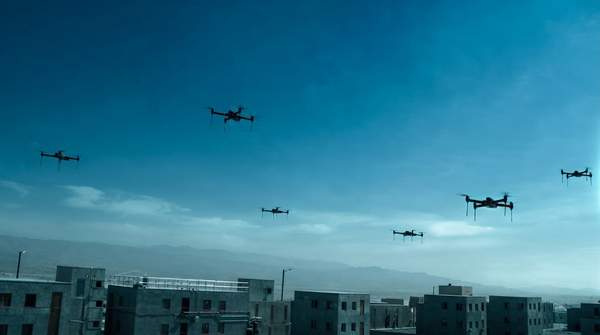
Swarming is the trend that most directly attacks traditional air-defense economics. The Australian Army Research Centre describes it as drones that communicate with each other to orchestrate a sortie — a group of unmanned aircraft coordinating as a collective rather than as individually piloted vehicles. The same passage places swarming alongside AI as the innovation most associated with future possibilities, which is an important framing: swarming is a documented development direction, not yet a settled capability.
The strategic logic is nonetheless clear. A defense optimized to track and engage individual aircraft faces a categorically different problem when the attacking element is a coordinated collective. Saturation becomes a design feature of the offense rather than an accident of mass. The center's pairing of swarming with AI-enabled drones is also telling: the coordination that defines a swarm is itself a computational problem, which is why the two trends advance together.
What the public evidence does not yet establish is the maturity of cross-domain swarming — coordinated groups operating simultaneously across air, land, and sea as components of larger mission architectures. The Australian Army Research Centre presents AI-enabled and swarming drones as future possibilities and next steps, and that framing should be preserved: this is the direction of documented development, not a description of fielded doctrine.
The Rise of Layered Counter-UAS Systems
Every offensive trend in unmanned systems generates its defensive counterpart, and Defense Security Monitor's reporting shows how quickly that countermeasure landscape is consolidating. Dardine describes a trend toward a system-of-systems approach in which a single platform may offer a variety of sensors and effectors, and reports that this trend seems to be growing significantly because the need for layered defense is pervasive.
The concrete example is instructive. Epirus's HAVOC system, as described by the company, is an autonomy-enabled evolution of its Expeditionary Directed Energy Counter-Swarm (ExDECS) system, designed as part of a layered, mobile protection solution to provide a resilient, non-kinetic option for low-altitude air defense formations. It also offers integration across the service's manned and unmanned ground vehicle fleets, enabling scalable deployment and flexible mission configurations.
Three features of that example carry strategic weight. First, the counter-swarm lineage is explicit: the defensive system is being designed against the swarming trend described above. Second, directed energy offers a non-kinetic effector, which matters for cost-per-kill against large drone groups. Third, integration across manned and unmanned fleets means counter-UAS is becoming a property of the whole formation rather than a dedicated specialist unit — a quiet but real organizational shift.
Strategic Implications: Adapting Military Structures and Doctrine
The second-order effects of these trends land on military organization itself. The clearest documented pattern is the compression of the decision cycle: when analysis moves to the point of action, as the National Defense Magazine analysis describes, the formation that benefits is the one whose command relationships and delegation of authority allow a human to act on a machine-generated recommendation in real time. Autonomy in the sensor-to-decision chain only pays off if the command structure is built to exploit it.
The counter-UAS side shows the same organizational logic from the defensive direction. A layered, mobile protection solution embedded in low-altitude air defense formations — integrated across manned and unmanned vehicle fleets, as Epirus describes for HAVOC — implies that counter-drone defense is distributed into existing formations rather than concentrated in separate units. That is a force-structure decision, not merely a procurement one.
The Australian Army Research Centre's framing of AI-enabled and swarming drones as the innovations associated with future possibilities and next steps also carries an institutional implication: the militaries that will benefit are those that begin adapting doctrine and organization now, while the technologies mature, rather than after they arrive. The evidence reviewed here is public analysis and industry reporting, not classified assessments, and it should be read as a well-documented direction of travel rather than a forecast of fielded capability.
Adapting to the Unmanned Battlefield
The decision this analysis supports is direct: militaries must continuously adapt organizational structures and operational doctrines to effectively integrate and counter evolving unmanned systems. The three trends documented here — AI-driven autonomy, swarm intelligence, and layered counter-UAS — are not separate procurement stories; they are mutually reinforcing pressures on how forces are organized, how decisions are delegated, and how defenses are layered.
The measurable indicator to watch is the establishment of specialized unmanned systems forces and the adoption of new, integrated operational concepts. Concretely, that means tracking whether services stand up dedicated unmanned-systems branches, whether counter-UAS capability migrates from specialist units into standard low-altitude air defense formations as the layered system-of-systems approach suggests, and whether doctrine formally incorporates machine-generated recommendations into the decision cycle. Each of those is observable in public force-structure announcements, and together they will show whether militaries are absorbing these trends or merely acquiring the hardware.