What separates an Artificial Intelligence of Things (AIoT) system from a traditional IoT deployment is not better sensors or faster networks alone—it is where analysis happens and where decisions are made. In a conventional IoT architecture, devices collect data, transfer it across networks, and store it in the cloud for later analysis. An AIoT architecture instead distributes intelligence across the stack: AI models run on devices and gateways at the edge as well as in the cloud, so analysis and automated decisions can occur close to where data originates. The result, as Synaptics explains in its AIoT guide, is faster response times and decision support built directly into the system rather than deferred to a remote data center.
Understanding the AIoT Architecture: A Layered Approach
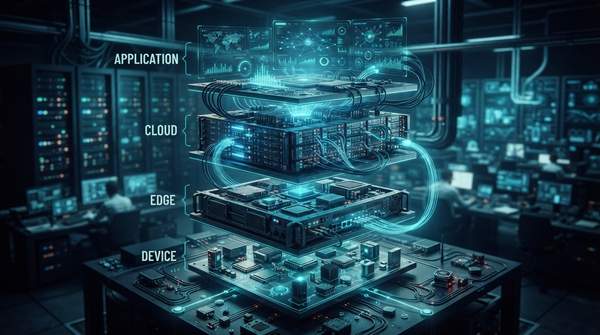
The AIoT architecture is best understood as an end-to-end structure in which each layer has a distinct job: generating data, processing it locally, orchestrating it at scale, and converting it into business value. Cisco describes the architecture as "various components and layers that work together to integrate AI technologies with IoT infrastructure." Telefónica frames the same idea from a design standpoint, arguing that AIoT requires an end-to-end architecture that defines "how intelligent IoT systems operate together, from data generation to obtaining useful information."
Cambridge's Computer Science and Technology department teaches the same progression in its AIoT course, describing it as "a progression from traditional IoT towards closed-loop intelligent systems" and asking students to understand "key components and architectures of AIoT systems across device, edge, cloud, and AI layers." Those four layers—device and asset, edge, cloud and platform, and application—form the working model this article walks through, and they map cleanly onto the components that vendors and researchers describe independently.
Layer 1: The Device and Asset Layer
The foundation of any AIoT system is the set of interconnected IoT devices that sense the physical world and act on it. Sensors capture conditions—temperature, vibration, location, video, or any other measurable signal—while actuators and connected assets translate digital commands back into physical action. Connectivity solutions, in Synaptics' description, "enable communication between devices," which is what turns isolated instruments into a coherent data-generating system.
This layer's importance is easy to underestimate, because in AIoT it is not just a passive data feed. FloLive's Anna Vainer notes that "without the sensory layer provided by IoT devices, AI would lack the operational context and environmental feedback needed to support automation and decision-making." In other words, the AI components higher in the stack are only as good as the operational reality this layer captures. The device layer is also where the architectural constraints begin: Cambridge's course emphasizes designing for "heterogeneous and resource-constrained platforms," meaning the hardware here varies widely in power, memory, and connectivity, and the rest of the architecture must accommodate that.
Layer 2: The Edge Computing Layer
The edge layer is where AIoT earns its distinction from traditional IoT. Edge devices are equipped, in Synaptics' phrasing, with "embedded AI chips or processors [that] handle data processing to improve response times." Instead of shipping every raw reading to the cloud, the edge performs analysis locally and acts on it.
FloLive describes this split concretely: "processing can occur at the edge, on or near the device, or in the cloud. Edge processing involves running AI models directly on local devices or gateways, enabling rapid analysis and response with minimal latency." The same source identifies when this matters most—"scenarios where real-time decision-making is critical, such as autonomous vehicles, industrial automation, or healthcare monitoring, and where bandwidth or privacy concerns limit sending raw data to the cloud."
Edge AI is also proving viable in demanding industrial settings. A peer-reviewed paper published in the MDPI journal Sensors demonstrates an AIoT architecture that "proposes the AIoT-based architecture" and "implements it and validates it over a FIWARE-based legacy sea traffic management IoT platform," showing that cognitive services can be layered onto existing IoT deployments rather than requiring a rebuild. The platform produced "reliable ETA predictions for vessel transport"—an example of local or near-local inference delivering operational decisions.
Layer 3: The Cloud and Platform Layer
Edge intelligence does not eliminate the cloud; it changes the cloud's role. Synaptics describes cloud infrastructure as the layer that "stores large volumes of data and supports remote device management and software updates," while AI models "are trained on historical or real-time data and deployed at the edge or in the cloud." In practice, this makes the cloud-and-platform layer the home of model training, large-scale analytics, device lifecycle management, and connectivity orchestration.
MarketsandMarkets, in a market report distributed by PR Newswire, breaks the platform layer into three complementary functions: "IoT device management platforms manage the entire usage lifecycle, from installation and operations to maintenance and upgrades"; "IoT application enablement platforms collect the requirements needed to develop and monetize AIoT applications"; and "IoT connectivity management platforms and services are designed to manage data flow within the network and between IoT devices and the cloud." For enterprise teams, the significance is that a modern AIoT platform is not merely a device dashboard—it is the coordination point that decides which models run where, and how insights from both edge and cloud are governed.
Layer 4: The Application Layer
The top layer converts intelligence into business outcomes. Telefónica's explanation is precise on the mechanics: "The application layer transforms insights into actions, visualisations, or automated workflows through dashboards, APIs, control interfaces, and corporate systems such as ERP, SCADA, WFM, billing, or CRM." Users interact with it through "mobile applications, web interfaces, or voice commands," and the layer's "main function… is to transform data into value for strategic decision-making and return on investment."
Cisco's explainer points to what those outcomes look like in practice: "AI identifies patterns and anomalies to help organizations anticipate and prevent equipment failures" in predictive maintenance, while security applications gain "real-time detection of anomalies and potential threats, which improves response times." Telefónica adds that the architecture as a whole "must be designed to promote modularity and abstraction, allowing new components to be integrated or changed as technology evolves"—a design principle that keeps the application layer from becoming a brittle, bespoke integration.
AIoT vs. Traditional IoT: A Paradigm Shift in Intelligence Distribution
With the four layers in place, the comparison with traditional IoT becomes structural rather than incremental. Traditional IoT sends raw data upward for centralized analysis and waits for instructions to travel back down. AIoT pushes analysis and decision-making outward to the edge for time-critical actions, while retaining the cloud for training, deep analytics, and strategic decisions. Cambridge's syllabus frames this as the core design problem: "Analyse trade-offs between latency, energy, communication, and model performance… under real-world constraints."
The table below contrasts the two architectures across five operational dimensions.
AIoT vs. Traditional IoT: A Comparative Overview
| Architectural Dimension | Traditional IoT | AIoT |
|---|---|---|
| Primary data processing location | Raw data is typically sent to the centralized cloud for processing and analysis—a path that can add latency from data transmission. | Processing occurs both at the edge (on or near devices) for real-time needs and in the cloud for complex analytics and model training. |
| Decision-making locus | Predominantly in the cloud after analysis, then communicated back to devices—centralized control that can limit real-time autonomy. | Autonomous decisions at the edge for immediate actions; the cloud handles strategic, long-term, and complex decisions. |
| Typical latency | Higher, due to round-trip transmission to and from the cloud; suits applications where real-time response is not critical. | Lower for critical actions, because processing and decisions happen locally; essential for immediate-response use cases such as autonomous systems. |
| Key enabler | Connectivity and cloud infrastructure for data aggregation, storage, and remote monitoring. | Edge computing with embedded AI capabilities, alongside cloud AI, enabling distributed intelligence and proactive action near the data source. |
Read across the rows, the table isolates one structural difference and one functional consequence. The structural difference is the insertion of an intelligent edge layer between sensors and cloud: AI models run locally on devices or gateways rather than only in a data center. The functional consequence follows directly—latency for time-critical decisions drops because they no longer depend on a round trip to the cloud, and devices gain autonomy to act without waiting for centralized instructions. The Sensors paper's maritime implementation shows the same principle in production: cognitive services such as ETA prediction were added to a legacy IoT platform through a modular, standards-compliant architecture, with the paper noting that "the modular approach together with standardization and open source will allow developers to add new cognitive services to the platform according to their needs."
Embracing Distributed Intelligence for Enterprise Innovation
Tech professionals should prioritize understanding and implementing AIoT architectures that leverage edge intelligence to enhance responsiveness and autonomy in enterprise applications. Concretely, that means designing for a hybrid distribution of AI processing—models trained in the cloud on historical and real-time data, then deployed at the edge where embedded AI processors handle local analysis—rather than treating the cloud as the sole decision point. The measurable indicators of success are visible in the architecture itself: increased deployment of AI models directly on edge devices, and a reduction in data latency for critical operational decisions.
Cambridge's course design brief captures the same test: whether a system can balance "latency, energy, communication, and model performance… under real-world constraints." A team that can point to local inference on its devices and faster critical-path decisions than its previous cloud-only design has made the paradigm shift measurable, not just conceptual.
Sources
- What Is AIoT? Artificial Intelligence of Things — Synaptics
- What is the Artificial Intelligence of Things (AIoT)? — Cisco
- AIoT: How artificial intelligence of things is impacting everything around us — Telefónica
- AIoT Solutions: Components, Use Cases & 6 Solutions to Know — Flolive
- Department of Computer Science and Technology – Course pages 2026–27: Artificial Intelligence of Things — CL
- AIoT Market worth $126.58 billion by 2032 - Report by MarketsandMarkets™ — Prnewswire