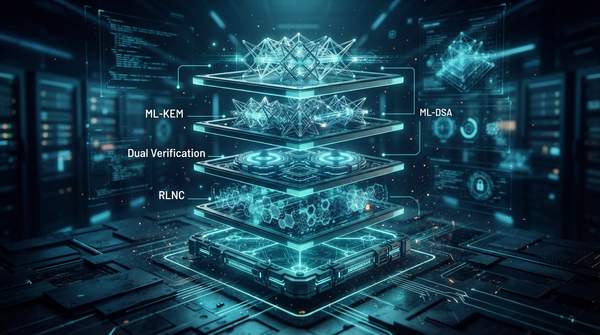
Splendor Labs' answer to the quantum threat is not a patch or a promised upgrade. According to the company, its live Layer-1 blockchain, the Splendor Quantum Chain, which launched in September 2026, combines four distinct technologies at the protocol level: ML-DSA-65 digital signatures, ML-KEM-768 network security, dual ML-DSA/SLH-DSA signature verification, and RLNC-based resilient data transport. Each component guards a different part of the network, from individual transactions to how blockchain data is distributed across nodes. This breakdown explains what each layer does and why the company's built-in approach matters for long-term asset security.
The Quantum Threat and Splendor Labs' Proactive Approach
The security problem Splendor Labs is designing against is well established. When NIST finalized its first three post-quantum encryption standards in August 2024, the U.S. agency noted that researchers are racing to build quantum computers that could break the encryption protecting nearly everything done online. For blockchain networks specifically, a cryptographically capable quantum computer would undermine the foundations of digital ownership, transaction authorization, identity and settlement.
Splendor Labs' founding argument is that this threat cannot be addressed retroactively for assets that must stay secure for decades. Tokenized assets and digital identities created today may still need protection in thirty years, long after conventional public-key cryptography could become breakable. The company therefore embedded post-quantum protection directly into the chain's core architecture rather than treating it as a future add-on, distinguishing its design from blockchain projects that plan to retrofit quantum resistance later.
Splendor Quantum Chain's Multi-Layered Quantum-Resistant Architecture
The clearest way to understand the design is to categorize each named technology by the security function it performs. The company describes four components working together across different layers of the network, covering transaction signing, protected node communications, multi-layer verification, and resilient distribution of blockchain data.
| Component | Standard / Technology | Function in the Blockchain | Qualification |
|---|---|---|---|
| ML-DSA-65 signatures | CRYSTALS-Dilithium, primary parameter set of a NIST-standardized algorithm | Quantum-resistant digital signatures for native transaction and block signing; verifies authenticity | The chain also supports ML-DSA-44 and ML-DSA-87 for flexibility and redundancy |
| ML-KEM-768 network security | CRYSTALS-Kyber, a NIST-standardized key-encapsulation algorithm | Establishes shared secret keys to protect communication between network participants and nodes | Replaces RSA/ECDH-style key establishment in post-quantum migration |
| Dual ML-DSA/SLH-DSA verification | SLH-DSA (Sphincs+), a NIST-standardized stateless hash-based signature scheme | Adds a second, conservative signature check for redundancy and flexibility in verification | Hash-based signatures serve as a backstop where lattice security assumptions are considered young |
| RLNC-based resilient data transport | Random Linear Network Coding | Resilient distribution of blockchain data, supporting integrity and availability across the network | Integrated into the foundation of the chain, not added later |
Read together, the table shows a layered defense: signatures secure what users and nodes assert, key encapsulation secures how parties communicate, dual verification guards against a single scheme failing, and network coding protects the data layer itself. The components are named by the company and described in its announcements; this article does not independently audit their implementation.
How Each Security Layer Functions
ML-DSA-65: Securing Digital Signatures and Transactions
ML-DSA-65 sits at the core of the chain. It is the primary parameter set of CRYSTALS-Dilithium, one of the algorithms NIST standardized in 2024, and in post-quantum migration it fills the role RSA and ECDSA signatures play today. On the Splendor Quantum Chain it signs native transactions and blocks, verifying the authenticity of each assertion of ownership or authorization. The chain also supports the ML-DSA-44 and ML-DSA-87 parameter sets, which the company says provides flexibility and redundancy across different security and performance trade-offs.
ML-KEM-768: Protecting Network Communication and Key Exchange
Signatures prove who sent something; key encapsulation protects what travels between parties. ML-KEM-768, built on CRYSTALS-Kyber, is a NIST-standardized public-key algorithm for establishing shared secret keys, the post-quantum replacement for RSA- and ECDH-based key establishment. Within Splendor's architecture, it secures network communication, protecting the channels through which nodes exchange data. This matters because a blockchain's consensus depends on honest communication between participants; if that channel were compromised, even correctly signed transactions could be exposed in transit.
Dual Verification with SLH-DSA: Enhanced Redundancy and Trust
The chain's dual-signature verification pairs ML-DSA with SLH-DSA, the standard based on Sphincs+, a stateless hash-based signature scheme. The design logic is conservatism: guides to the NIST algorithm suite describe SLH-DSA as a deliberately conservative backstop for long-lived signatures where the security assumptions of lattice schemes like ML-DSA are considered too young to rely on alone. By requiring verification across two mathematically distinct approaches, the architecture hedges against a future cryptanalytic breakthrough against either one.
RLNC-Based Resilient Data Transport: Ensuring Data Integrity and Availability
The fourth component is architectural rather than purely cryptographic. Random Linear Network Coding underpins the chain's resilient data transport, which the company says ensures the resilient distribution of blockchain data across the network. Where the first three layers protect identities, transactions and communications, this layer protects availability, the property that the ledger's data remains intact and reachable even under disruption. It is integrated into the chain's foundation, completing coverage from user transactions down to network-level data movement.
Future Applications and Strategic Vision for Splendor Quantum Chain
The architecture is built for a specific market. Splendor Labs points to the convergence of blockchain and traditional finance, noting that institutions including BlackRock, J.P. Morgan, Goldman Sachs, Citi, Franklin Templeton and Fidelity are developing digital-asset and tokenization initiatives. The chain is intended as secure infrastructure for institutional finance and tokenized assets, with self-custody solutions and integration approaches tailored for institutional frameworks.
Two further directions follow. First, the company says the chain will support the growing activity of AI agents in trading and asset management, providing authentication and settlement infrastructure for verifiable transactions between autonomous systems and institutions, including through integration with DecenterCloud, an AI-native technology marketplace. Second, Splendor Labs aims to expand into global internet and enterprise authentication, with quantum-resistant authentication positioned as an essential component of future digital infrastructure, delivered progressively so institutions can strengthen defenses without wholesale replacement of existing systems.
The Future of Quantum-Resistant Blockchain: A Foundational Shift
Founder and CEO Todor Ivanov frames the project in architectural terms: "We designed Splendor Quantum Chain around where we believe digital infrastructure is going, not simply where it is today." The company's wager is that quantum resistance, like consensus itself, must be a protocol-level property rather than an application-level feature.
Organizations and developers considering blockchain solutions for long-term asset security and future-proof digital infrastructure should evaluate platforms like Splendor Quantum Chain that integrate quantum resistance at an architectural level. The measurable indicator to watch is the continued adoption of NIST-standardized post-quantum cryptographic algorithms in new blockchain deployments and the expansion of Splendor Quantum Chain into institutional finance and AI agent ecosystems. Those two signals, more than any announcement, will show whether built-in quantum resistance becomes the industry baseline.
Sources
- Einnews
- Splendor Labs Delivers Quantum-Resistant Blockchain Infrastructure to Users Worldwide — GlobalFinTechSeries
- ML-KEM, ML-DSA, SLH-DSA: The NIST Post-Quantum Algorithms Explained — Evertrust
- Post-Quantum Cryptography — CSRC
- NIST Releases First 3 Finalized Post-Quantum Encryption Standards
- Splendor Labs Completes Quantum Security Milestone, Sets Sights on Global Internet and Institutional Security Markets — The National Law Review
- Splendor Labs’ Blockchain Offers Quantum-resistant Security. — Quantum Zeitgeist